

Rolling hills under open sky

Insights

Notes on measuring what matters

Practice notes on listening-led assessment, field design, benchmarking and responsible AI.

Latest notes

Ideas we use in our work.

People in conversation
Practice note

Listening at scale: why participant voice belongs at the centre of impact measurement

Most programmes collect plenty of data about activities: sessions held, kits distributed, people registered. Far fewer ask the people they serve whether their lives actually changed.

Read the note

Listening-led measurement flips that. It starts with short, consistent conversations with participants about what changed for them, what mattered most, and what could be better. Because the questions are consistent, answers can be compared across sites and over time.

Done well, it is fast, affordable and respectful. It gives decision-makers a direct line to the people the programme exists for — and it often surfaces problems that no dashboard would show.


Patients at a health camp
Field design

Designing a one-minute patient data sheet

At a busy health camp, every minute of a doctor’s time is precious. Any data system that slows consultations will be abandoned by lunchtime.

Read the note

The answer is ruthless simplicity: a single page, mostly tick-boxes, covering only what will be used. Registration and vitals belong at their own desks. The doctor records diagnosis and advice, not paperwork.

We are applying these principles in our in-progress pilot with the Dhanwantri Seva Yatra 2026. The test of the design is simple: it has to be usable on the busiest day of the camp.

Forest landscape
Framework

Human, Nature, Future: three lenses for reading impact

Every programme leaves traces in three places: in people’s lives, in the environment, and in the capacity of people and systems to handle what comes next.

Read the note

The Human lens asks what changed for people. The Nature lens asks what the programme left behind in land, water and climate. The Future lens asks whether gains will last beyond the project cycle.

Using all three keeps assessments honest. A programme can look successful through one lens and fragile through another, and decision-makers need to see both.

Abstract network visual
AI

Responsible AI in social programmes: questions to ask before you deploy

AI tools are arriving in health, agriculture, education and public services. Before deployment, a few questions matter more than any model benchmark.

Read the note

Who will use it, and can they? Is the data it learned from representative of the people it will serve? What happens when it is wrong, and who notices? How will frontline workers’ roles change?

An AI readiness assessment answers these questions with evidence from users and frontline staff, so organisations can deploy carefully, or decide not to.

Analyst reviewing data
Method

Benchmarking without inventing baselines

Benchmarks are powerful: they tell an organisation what good looks like. They are also easy to misuse.

Read the note

A fair benchmark compares like with like: the same questions, asked in the same way, of similar populations. Where that is not possible, the honest answer is to say so and benchmark against your own results over time.

Our benchmarking work always states its basis, so readers know exactly what is being compared and how much weight the comparison can bear.

Person using a phone
Digital

Digital adoption is not digital impact

Downloads, registrations and log-ins are easy to count, and easy to mistake for success.

Read the note

Impact lives further down the funnel: repeat use, trust, time and money saved, and problems actually solved. It also lives in the people who never get past the first screen.

Assessing digital services means following users through that funnel, including those who drop off, and asking what would make the service work for them.

Stay in touch

Get new notes by email.

Write to us and ask to join the notes list. We send occasional notes on assessment practice, nothing else.

Join the notes list
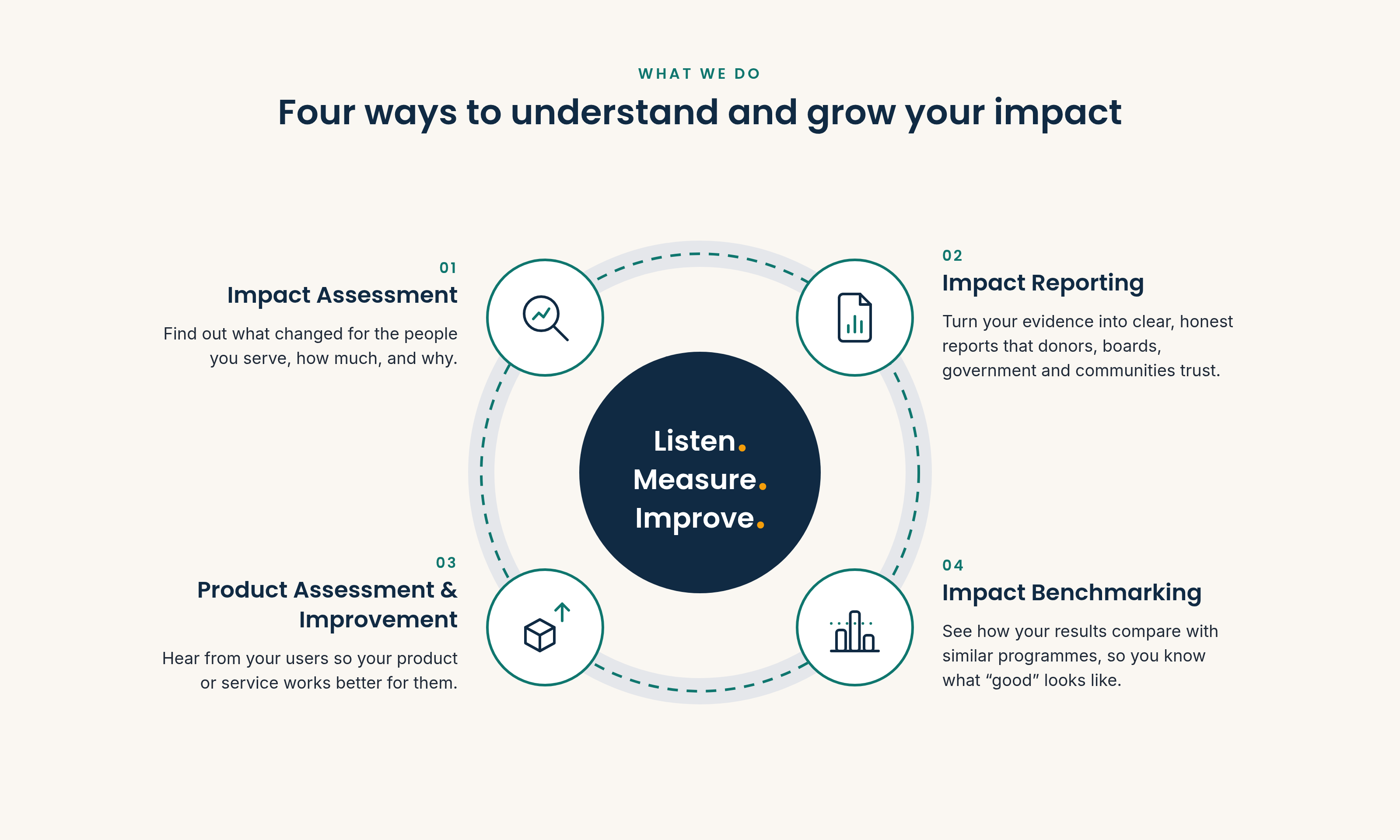
Four ways to understand and grow your impact: impact assessment, impact reporting, product assessment and improvement, impact benchmarking

Ready to see what your impact really looks like?

Book a free scoping consultation. We will listen first, then propose an assessment that fits your programme, timeline and budget.

Get a quote info@pathmarg.com